Two rooms, two maps
Take a rat that has spent the morning learning a circular arena in one room. Carry it down the hallway, set it down in a second arena that looks almost identical — same shape, same size, same wells — and let it explore. Record the same neurons in both rooms. The cells that fired in the northeast corner of the first arena will not, in general, fire in the northeast corner of the second. Most of them will fire somewhere else entirely. Some will go silent. A few will start firing for the first time all day. The hippocampus has built a fresh map.
This is remapping, and it is one of the more disorienting facts about the hippocampal code. It was first reported by Muller and Kubie in 1987 — change the shape or color of the recording arena enough, and place fields rearrange in ways that bear no obvious relation to the original layout. The relationship between the two maps, across thousands of pairs of cells, looks statistically like noise. The same population of neurons supports two independent representations of two environments, with no shared coordinate frame between them.
There are softer flavors of this. Rate remapping — same fields, different firing intensities — happens when you change the wallpaper but not the geometry. Global remapping, the kind that matters for the experiments in this site, happens when the rat treats the two environments as fundamentally different places. The key feature is that the second map is not a perturbation of the first. It is a separate object, allocated and maintained on its own.
Same cells, different worlds
The toy below is the simplest possible demonstration. Six neurons live across two arenas. Click into either room to drop the rat there, then drag it around. Watch which neuron fires where. PC-01 has a place field in the upper-left of Room A and another in the lower-right of Room B — same cell, two unrelated locations. PC-03 fires only in Room A; PC-05 fires only in Room B. Real recordings show all of these patterns.
The two boards share the same six neurons. Click into either room to put the rat there, then drag it around. Watch which cell fires where — the same neuron has a place field in Room A and an unrelated place field in Room B (and a couple of cells go silent in one room entirely).
Why does this matter for an experiment about replay? Because remapping is what gives replay a content that you can identify. If every memory used the same neural code, you could not, even in principle, tell from a burst of spiking which memory was being replayed. Remapping breaks that ambiguity. Two rooms produce two distinct firing patterns; an arbitrary spike burst can be tested against each pattern; the better-fitting pattern is, with reasonable confidence, the memory the brain is currently rehearsing.
That single fact is the whole leverage of the closed-loop design. Train an animal in two rooms, let it sleep, decode each replay event in real time, and you can selectively intervene on one memory while leaving the other alone. The control for “we disrupted memory of Room A” is, conveniently, the same animal’s memory of Room B — recorded from the same neurons, formed on the same day, consolidated in the same sleep. The two-room paradigm is not flavor. It is the within-subject control that makes the result possible to interpret.
The cheeseboard
The arena itself is borrowed from Dupret and colleagues, who introduced it for studying spatial memory in rats with hippocampal recordings. It is a flat circular table, about a meter and a half across, drilled with eighty-one shallow wells in a grid. On any given day, three of those wells are baited with a small piece of food. The rat starts at the edge, runs onto the board, sniffs around until it finds a reward, eats, runs to another, and so on, until all three are emptied. Then it is taken off, the wells are re-baited, and the trial repeats. Within ten or fifteen trials a healthy rat is heading straight to the rewarded wells from the start position; within a session it has acquired a spatial memory specific to that board, in that room.
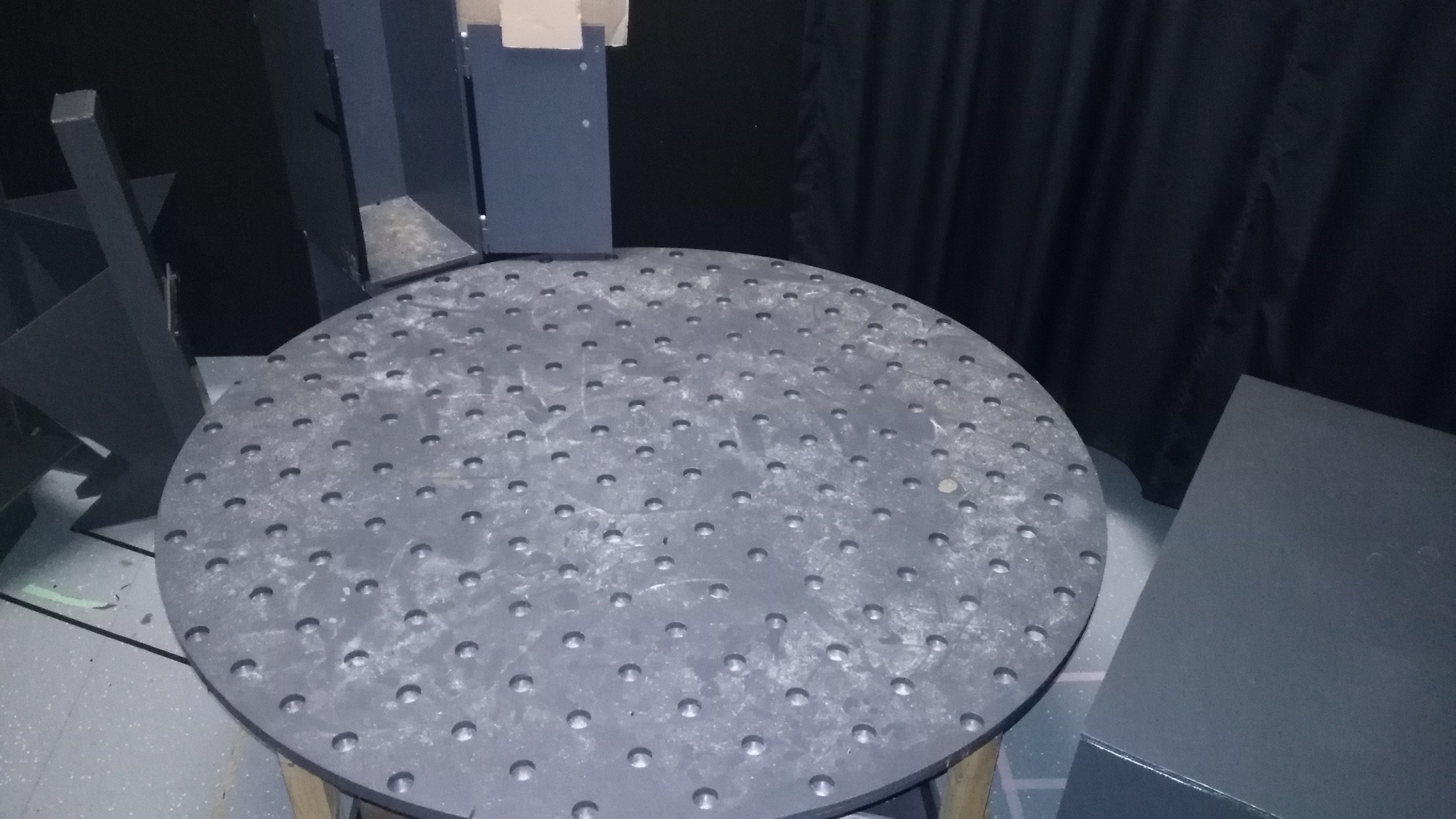
Crucially, the two rooms in this paradigm are not subtle perturbations of each other. They differ in lighting, wall cues, surrounding furniture, ambient sound, and the experimenter standing nearby. From the rat’s perspective they are categorically different places. The hippocampus responds in kind: the maps are decorrelated, the firing populations partly non-overlapping, the “Room A code” and the “Room B code” statistically independent. When the rat sleeps and a Room A replay event comes through, it does not look like a Room B event in any meaningful sense. That is the discriminability the closed-loop decoder needs.
The shape of a session
A typical recording day moved through six phases. The phases below are not unique to this work — the structure is fairly standard for sleep-and-memory experiments — but the numbers and the closed-loop manipulation in the long rest are specific to the experiments in this site. Drag the marker to step through.
The interesting work happens in two of those phases. The 4-hour rest is when memories consolidate, when sharp-wave ripples and replay events fire by the thousand, and when the closed-loop system has its window. The probe is the behavioral read-out: did the targeted memory weaken? Did the control memory survive? Almost everything else — the calibration pulse, the baseline rest, the post-task recording — exists to make those two phases interpretable.
Two rooms; two maps; one long sleep between them. The next chapter is about what those maps do when the animal closes its eyes.